Autistic burnout in children: signs, causes, and what helps recovery
Introduction
Your child comes home from school and heads straight to their room. They refuse dinner, snap at a sibling, and seem unable to manage tasks they handled last week. Teachers say they were “fine” at school. You wonder if it is laziness, anxiety, depression — or something else entirely.
For many autistic children and young people, this pattern has a name: autistic burnout.
A word of caution before we go further. Almost everything published on autistic burnout comes from studies of adults — many of them reflecting back on their teenage years, some recognising the experience only after a late diagnosis. The childhood picture is only beginning to be studied directly. So read what follows as a well-grounded working model, not a settled clinical fact, and hold it alongside what you actually see in your own child. The value of naming burnout early is that it can prevent the kind of long-term collapse that leaves a child unable to attend school, socialise, or manage daily life. The risk of naming it too readily is that burnout can look like other things that need a different response — which is why a section below is devoted to telling them apart.
What Is Autistic Burnout?
Autistic burnout is a state of intense physical and mental exhaustion, accompanied by a reduced ability to manage daily demands and a loss of skills the person previously had. It is not the same as being tired, stressed, or temporarily overwhelmed.
The concept was first defined in the academic literature only in 2020, when Raymaker and colleagues interviewed autistic adults and analysed online accounts to characterise it [1]. They described three core features, which later work has repeatedly echoed:
- Chronic exhaustion that rest does not easily relieve
- Loss of skills — communication, self-care, executive function, or social abilities
- Reduced tolerance for sensory input, social interaction, and change
Around this core sit emotional distress — irritability, anxiety, a sense of failure — and functional collapse, meaning real difficulty maintaining school, routines, or relationships.
A 2026 qualitative study by Ali, Mandy and Happé compared adults diagnosed in childhood with those diagnosed later, and found they describe burnout in strikingly similar terms — though those diagnosed later often recognised it only in hindsight [2]. The implication for parents is important: a child may have no words for “I am burned out,” but their behaviour will show it. The same study captured burnout’s two faces — sometimes a powering down of mind and body, sometimes an overactivation with heightened sensory sensitivity — both resolving into a craving for social and sensory rest.
What Burnout Looks Like in Children
Here is where the evidence is thinnest, so this list should be read as a guide to what may signal burnout, not a checklist that confirms it. Because most research involves adults, parents and clinicians have to infer the childhood presentation. Commonly described signs include:
- After-school collapse: moodiness, withdrawal, tears, or aggression as soon as they are home
- Weekend or holiday “hibernation”: needing far more rest than seems proportionate
- Skill regression: losing ground in toileting, eating, communication, or self-care
- A change in stimming: either seeking much more, or suppressing it because they are too depleted
- Heightened sensory sensitivity: sounds, textures, or lights that were tolerable become unbearable
- School avoidance: refusal, lateness, or distress at the prospect of attending
- Emotional volatility: small requests trigger disproportionate upset
- Loss of interest: even favourite activities feel like too much
There is now a little direct paediatric evidence. A 2024 UK audit by Siggers and Day reviewed the notes of 20 autistic children who had been unable to attend school for at least three months; 90% had an Education, Health and Care Plan, and every one of them showed chronic exhaustion, loss of skills and interests, increased sensory needs, social withdrawal and mood dysregulation [6]. It is a small, retrospective study, but it is one of the first to document the pattern in children rather than in adults remembering childhood.
Clarey and colleagues’ 2026 study of autistic adults placed shame and identity disruption at the centre of burnout, not just exhaustion [5]. In children this may surface as “I can’t do anything right” or “I’m a bad person.” Statements like these should be taken seriously rather than corrected away.
A note on who this describes. The picture above — masking all day at school, collapsing at home — fits verbally able children who can hide their differences in the first place. Burnout also happens to children with higher support needs, but it may look different: not a dropped mask but an escalation of what gets labelled “challenging behaviour,” or a quiet loss of the few functional skills a child had. The absence of masking does not mean the absence of burnout.
How Burnout Differs From Depression and Anxiety
Distinguishing burnout from depression and anxiety matters because the response differs, and because getting it wrong cuts both ways: a depressed child treated only with “less demand” may miss necessary mental-health care, while a burned-out child pushed toward “resilience” may be driven further down. The three can also coexist. This comparison is offered as a way of thinking, not a diagnostic tool.
| Feature | Autistic Burnout | Depression | Anxiety |
|---|---|---|---|
| Onset | Often linked to sustained demand or masking | May be more gradual or episodic | Often worry-focused and anticipatory |
| Does rest help? | Partially, in a low-demand environment | Often not with rest alone | May ease when the worry resolves |
| Skill loss | Prominent and specific | Common but more general | Less typical |
| Triggers | Masking, sensory overload, transitions, social load | May have no clear trigger | Often tied to specific fears |
| What aids recovery | Low demand, predictability, autonomy | Usually broader mental-health support | Graded exposure, reassurance |
If a child shows signs of depression — persistent low mood, loss of pleasure in almost everything, changes in sleep or appetite, or any thoughts of self-harm — a professional mental-health assessment is essential and should not wait on a burnout explanation.
Why Children Burn Out
The causes of autistic burnout are not flaws in the child. They are the result of a mismatch between what the child needs and what the environment demands.
Masking and Camouflaging
Many autistic children learn to hide their autistic traits at school — forcing eye contact, suppressing stims, mimicking peers, and enduring sensory discomfort without complaint. A 2025 co-twin study by Conde-Pumpido Zubizarreta and colleagues found that camouflaging was associated with raised long-term biological stress, measured through hair cortisol [3]. A 2026 scoping review by Hodge and Meltzoff, drawing on 48 studies, found a consistent link between camouflaging and poorer mental health, including burnout — and noted that the “assimilation” type of masking, trying to blend in, tracked most closely with distress [4].
For children, masking is often reinforced by well-meaning adults. “He looked at me when I spoke to him.” “She managed the whole day without a meltdown.” These can be the signs of successful masking — and masking is exhausting. Perhaps the single most useful shift a parent or teacher can make is to stop reading a calm, compliant school day as proof that all is well.
Sensory and Cognitive Load
Schools are sensory-rich and unpredictable. Fluorescent lights, noise, smells, unexpected changes, and social demands accumulate across the day. Autistic children often spend enormous cognitive resources simply staying regulated. By home time, the tank is empty — and home, the safe place where the mask can finally drop, is where the collapse becomes visible.
Social and Interpersonal Strain
School is not just academically demanding — it is socially demanding. Many autistic children work hard to integrate, to read unwritten social rules, and to cope with a stream of different personalities, expectations, and communication styles. That constant social vigilance is draining, and it is invisible to adults who only see a child “getting on with it.”
Academic and Organisational Load
Burnout is not only about social and sensory stress. Excessive workload, academic struggles that stem from a spiky developmental profile, difficulties with self-organisation, and slow or effortful handwriting — often linked to dyspraxia — all add to the daily load. A child who is bright but cannot get their thoughts onto paper fast enough, or who cannot keep track of homework, equipment, and deadlines, is expending far more energy than their output suggests.
Unrecognised Comorbidity
Unrecognised comorbidity — especially ADHD — is another important hidden driver. A child who is constantly fighting their own attention, impulsivity, or executive function without understanding why, or without support, is burning through reserves that their peers do not have to spend.
Demands Exceeding Capacity
Burnout occurs when demands consistently exceed a child’s capacity to recover. This is not a question of resilience. It is about an environment asking too much for too long without enough downtime, autonomy, or support.
Bullying and Social Exclusion
Bullying is an important and often overlooked driver of autistic burnout. Autistic children are disproportionately likely to be bullied, excluded, or misunderstood by peers. The daily work of navigating social rejection, predicting social threats, and recovering from humiliation adds a heavy layer to the demands of school. Even when no single incident seems “serious,” the cumulative effect can push a child toward burnout.
Prevention: Building a Sustainable Rhythm
Prevention is easier than recovery. The goal is not to strip away all demands but to match them with recovery time and give the child some agency.
1. Reduce the Need to Mask
- Tell the child explicitly that they do not need to hide stims at home
- Avoid praising them for “looking normal” or “behaving well” in ways that require masking
- Ensure at least one environment — usually home — where they can be fully themselves
2. Protect Downtime
- Treat rest as non-negotiable, not a reward to be earned
- Build in decompression time after school before homework, clubs, or social activities
- Limit after-school activities, especially on consecutive days
3. Increase Predictability
- Use visual timetables, calendars, and advance warning of changes
- Where change is unavoidable, explain what will happen and what the options are
- Reduce decision fatigue by offering limited, clear choices
4. Respect Sensory Needs
- Provide noise-reducing headphones, dimmer lighting, weighted items, or fidget tools
- Allow movement breaks and access to a quiet space at school
- Do not treat forcing tolerance of sensory input as a goal in itself
5. Match Demands to Capacity
- Watch for early warning signs and reduce demands before collapse
- Prioritise: what genuinely matters today, and what can wait?
- Negotiate deadlines and break tasks into smaller steps
6. Preserve Autonomy
- Offer genuine choices within boundaries
- Avoid power struggles over low-stakes demands
- Recognise that some children experience a demand as a threat, not a challenge
Recovery: When Burnout Has Already Happened
If a child is already burned out, the priority is to reduce the load long enough for recovery to happen.
Lower the Bar, For Now
Recovery requires a temporary reduction in demands. That might mean part-time school attendance with a gradual return, pausing non-essential homework and clubs, accepting some regression in self-care without pressure, or allowing more special-interest time and solitude if those are restorative.
Create a Low-Demand Environment
- Reduce questions and instructions
- Keep surroundings calm, quiet, and predictable
- Let the child lead: eat when hungry, sleep when tired, engage when ready
Rebuild Energy Before Skills
Do not push for lost skills to return until the child has recovered energy. Trying to “catch up” too soon tends to prolong burnout. Skills usually come back once the nervous system has had time to recover.
Stay Connected
Even a child who wants to withdraw needs connection kept low-pressure. Sitting nearby, offering favourite foods, or sharing a special interest without demanding conversation all communicate safety.
What Schools Can Do
Schools are often where the mismatch between demands and capacity is greatest. Reasonable adjustments that lower burnout risk include:
- A trusted adult the child can check in with
- A designated quiet space for breaks
- A reduced timetable or flexible start times
- Permission to use sensory tools and to stim as needed
- Advance warning of changes, and the option to opt out of non-essential activities
- Assessment of effort that does not depend on eye contact, sitting still, or verbal participation
The most protective schools recognise that a child who appears fine may be masking intensively, and they look beneath the surface.
When to Seek Professional Help
Burnout can often be managed at home and school, but professional help is needed if:
- The child cannot attend school or engage in daily life for more than about two weeks
- There are any signs of depression, self-harm, or suicidal thoughts
- Eating, sleeping, or self-care are significantly disrupted
- The family is struggling to cope
- Recovery stalls despite genuinely reducing demands
A paediatrician, clinical psychologist, or autism specialist can help distinguish burnout from depression or anxiety and support a phased recovery plan.
The Bigger Picture
Autistic burnout is not a failure of the child or the parent. It is a signal that the environment is asking more than the child can sustain. The evidence we have — almost all of it from autistic adults, now beginning to be echoed in children — points consistently to the same drivers: sustained masking, sensory overload, and unrelenting demand without recovery. Prevention depends on reducing those pressures and building a sustainable rhythm. And it depends on believing children when they show us, through behaviour rather than always through words, what they need.
Visual Summary
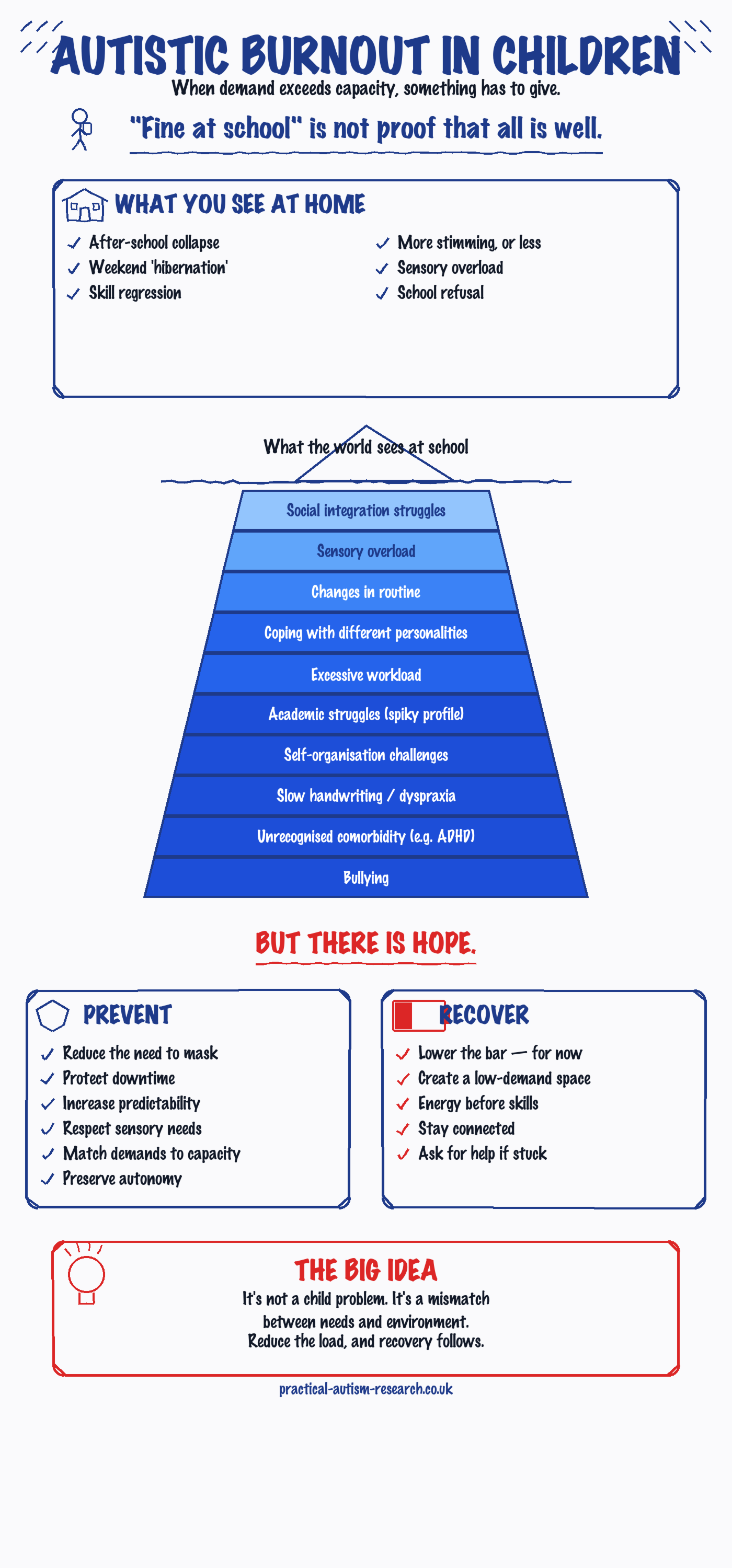
Download or share this summary: signs to watch for, what’s underneath, and how to prevent and recover from autistic burnout.
References
-
Raymaker DM, Teo AR, Steckler NA, et al. “Having all of your internal resources exhausted beyond measure and being left with no clean-up crew”: Defining autistic burnout. Autism in Adulthood. 2020;2(2):132–143. https://doi.org/10.1089/aut.2019.0079
-
Ali D, Mandy W, Happé F. How does ‘autistic burnout’ feel? A qualitative study exploring experiences of earlier and later-diagnosed autistic adults. Autism. 2026;30(4):1014–1027. https://doi.org/10.1177/13623613261422117
-
Conde-Pumpido Zubizarreta S, Isaksson J, Faresjö Å, et al. The impact of camouflaging autistic traits on psychological and physiological stress: a co-twin control study. Molecular Autism. 2025;16(1):59. https://doi.org/10.1186/s13229-025-00695-9
-
Hodge EK, Meltzoff KK. The relationship between autistic camouflaging and mental health: a scoping review. Frontiers in Psychiatry. 2026;17:1701615. https://doi.org/10.3389/fpsyt.2026.1701615
-
Clarey MM, Ireland MJ, Abel S, Brownlow C. Beyond exhaustion: shame, identity disruption, and functional collapse in autistic burnout. Autism. 2026;30(6):1519–1531. https://doi.org/10.1177/13623613261444797
-
Siggers G, Day B. Beyond school avoidance: recognising, identifying, and addressing autistic burnout in children. BJPsych Open. 2024;10(Suppl S1):S? Abstract. https://doi.org/10.1192/bjo.2024.433
Note: Research into autistic burnout in children is still emerging. Most current evidence comes from studies of autistic adults reflecting on their experiences, supplemented by a small but growing number of studies in children. The strategies here are informed by that evidence and by clinical experience, but should be adapted to each child and discussed with the child’s healthcare provider.