Potty Training and Autism: Why It Takes Longer and What Actually Helps
Toilet training is one of those milestones that parents tend to compare, whether they mean to or not. When your child’s nursery peers are dry and your four, five, or six year old is still in pull-ups, it can feel isolating. If your child is autistic, you may have found that the standard advice simply does not work, and that nobody seems to have a satisfying explanation for why.
This is not because your child is being difficult. There are real, identifiable reasons why toileting is more challenging for many autistic children, and there are evidence-based strategies that can help.
How Common Is Delayed Toileting in Autism?
Studies consistently show that autistic children achieve independent toileting later than their neurotypical peers. A large population-based study found that the median age for daytime dryness in autistic children was around 3.5 to 4 years, compared to approximately 2.5 years in non-autistic children. For some, the process extends well into the school years (1).
Approximately 30 to 40 percent of autistic children experience significant toileting difficulties beyond the age that would typically prompt clinical concern (2).
Why Is It Harder?
Several factors, often interacting with each other, contribute to delayed toileting in autism:
Interoception difficulties. Interoception is the ability to notice and interpret signals from inside the body, including bladder and bowel fullness. Many autistic children have reduced interoceptive awareness, meaning they may genuinely not notice that they need to go until it is urgent, or at all (3).
Sensory sensitivities. The bathroom is a sensory minefield. The cold seat, the sound of flushing, the bright lights, the echo, the feel of unfamiliar clothing arrangements. Any of these can be genuinely distressing for a child with sensory processing differences.
Routine rigidity. If a child has always used a nappy, the nappy is part of their routine. Changing this can provoke significant anxiety. Equally, an autistic child may be willing to use the toilet at home but refuse at nursery, because it is a different toilet in a different environment.
Communication barriers. A child needs to be able to recognise the body signal, connect it to the concept of using the toilet, and then communicate the need, all in real time. For children with language delays or who are minimally verbal, this chain has several points where it can break down.
Motor planning challenges. The sequence of actions involved in toileting (walking to the bathroom, managing clothing, sitting correctly, wiping, flushing, washing hands) is a complex motor plan. Children with dyspraxia or motor planning difficulties, which are common in autism, may find this genuinely hard to execute even when they understand what is expected.
What the Evidence Says About Approaches That Work
Structured Behavioural Approaches
The strongest evidence base is for systematic, behaviourally informed approaches. A systematic review by McLay and colleagues found that the most effective interventions shared several features: scheduled toilet sits, positive reinforcement for successful toileting, gradual fading of prompts, and careful tracking of patterns (4).
This does not mean rigid or punitive approaches. It means being consistent, providing clear expectations, and making success achievable.
Visual Supports
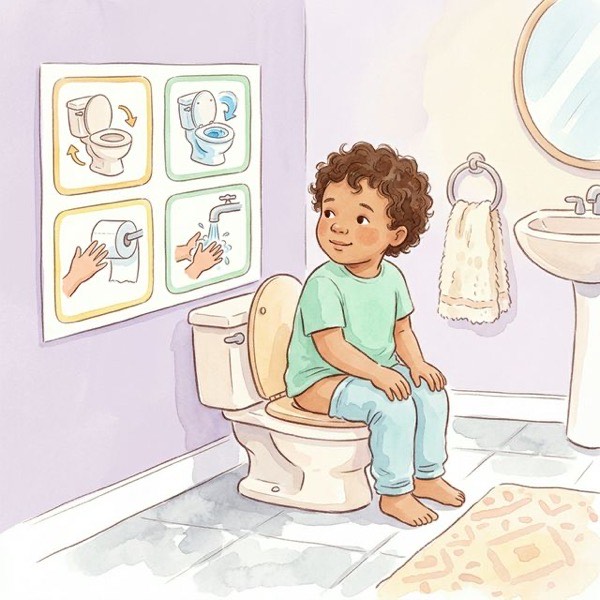
Visual schedules showing the steps of toileting are consistently highlighted as beneficial. A visual sequence (pull down trousers, sit on toilet, try to go, wipe, flush, wash hands) reduces the cognitive and language demand and makes the routine predictable (5).
Social stories, short illustrated narratives that describe what will happen and why, can help prepare a child for the change in routine.
Sensory Adaptations
Small environmental changes can make a significant difference:
- A padded or warm toilet seat
- Reducing bathroom echo with a mat or towel
- Allowing the child to flush after they have left the room
- Providing a footstool for stability (and to support positioning for bowel movements)
- Letting the child wear comfortable, easy-to-manage clothing
Timed Voiding
Tracking when your child wets or soils for a week or two can reveal natural patterns. You can then schedule toilet sits just before these times, increasing the chance of success in the toilet. This is often more effective than the generic “every two hours” advice.
Night-Time Dryness: A Separate Challenge
It is important to know that night-time dryness is a largely separate developmental process from daytime continence. It depends on the maturation of hormonal signals (specifically ADH, antidiuretic hormone) and the capacity of the bladder. For many autistic children, nocturnal enuresis persists well beyond the age at which it resolves in neurotypical peers (6).
If your child is dry during the day but not at night, this is normal and common. Bedwetting alarms have a reasonable evidence base for older children who are motivated, but they require careful introduction for children who may find the alarm sensorily aversive.
When to Involve a Doctor
You should speak to your child’s GP or paediatrician if:
- Your child is over 4 and showing no signs of readiness or interest despite consistent support
- There is chronic constipation (very common in autism and a major barrier to toileting success)
- There is overflow soiling (encopresis), which is almost always related to underlying constipation
- Your child was previously dry and has started wetting or soiling again
- Toileting is causing significant distress to the child or family
Constipation deserves special mention. It is extremely common in autistic children, often underdiagnosed, and can completely undermine toilet training. If your child is straining, passing hard or very large stools, or going less than three times per week, address this before intensifying toilet training (7).
Practical Tips for Parents
- Wait for signs of readiness, not a specific age. Readiness signs include showing awareness of being wet or soiled, being able to sit still for a few minutes, and following simple instructions.
- Use a visual schedule and keep it consistent.
- Reward success, do not punish accidents. Praise, stickers, or a preferred activity after a successful toilet sit works better than any negative response to accidents.
- Track patterns before you begin training. Data is your friend.
- Make it sensory-friendly. Ask your child (or observe carefully) what bothers them about the bathroom.
- Be prepared for it to take longer. This is a marathon, not a sprint. Progress may be non-linear.
- Address constipation first. If the plumbing is not working, the training will not stick.
References
- Dalrymple NJ, Ruble LA. Toilet training and behaviors of people with autism: parent views. Journal of Autism and Developmental Disorders. 1992;22(2):265-275.
- Cicero FR, Pfadt A. Investigation of a reinforcement-based toilet training procedure for children with autism. Research in Developmental Disabilities. 2002;23(5):319-331.
- Fiene L, Brownlow C. Investigation of interoception and alexithymia in autism: a systematic review. Neuroscience & Biobehavioral Reviews. 2015;47:410-436.
- McLay L, et al. Toilet training children with autism spectrum disorder and other developmental delays: a systematic review. Research in Autism Spectrum Disorders. 2015;14-15:106-122.
- Kroeger KA, Sorensen-Burnworth R. Toilet training individuals with autism and other developmental disabilities: a critical review. Research in Autism Spectrum Disorders. 2009;3(3):607-618.
- von Gontard A, et al. Enuresis and urinary incontinence in children and adolescents with autism spectrum disorder. Journal of Pediatric Urology. 2015;11(3):141.e1-141.e7.
- Pang KH, Croaker GDH. Constipation in children with autism and autistic spectrum disorder. Pediatric Surgery International. 2011;27(4):353-358.