Introduction: Understanding the Challenge
Imagine this scenario: you’re preparing for your child’s routine clinic visit or blood test, but the mere mention triggers an immediate meltdown. For autistic children, what seems like a straightforward medical appointment to neurotypical individuals represents something far more complex and overwhelming. The bright fluorescent clinic lights, sharp antiseptic smells, the cold snap of a tourniquet against skin, unfamiliar voices echoing in waiting rooms—these aren’t minor inconveniences. They’re a sensory storm that can completely overwhelm a nervous system already working overtime to process the world.
As a clinician, I’ve witnessed this scenario unfold countless times: what feels routine and manageable to medical staff and neurotypical families becomes an all-consuming battleground of sensory assault, disrupted routines, and escalating anxiety. Children may refuse to enter the building, become physically aggressive, shut down completely, or experience such distress that the medical procedure becomes impossible to complete safely.
But here’s the encouraging truth: with understanding, preparation, and science-backed strategies, we can transform these dreaded appointments from traumatic ordeals into manageable, even successful, experiences.
The Science Behind the Struggle
Sensory Processing Differences
To support autistic children effectively, we first need to understand why medical environments pose such unique challenges. Autistic individuals often experience sensory processing differences—their brains receive, interpret, and respond to sensory information differently than neurotypical brains.
Sensory hypersensitivity means that everyday stimuli are processed with amplified intensity:
- Fluorescent lights don’t just illuminate; they hum, flicker, and create an aggressive visual assault
- Hand sanitizer doesn’t merely smell clinical; it hits like an overwhelming chemical wave that burns the nostrils
- The texture of vinyl examination chairs doesn’t just feel smooth; it creates an uncomfortable sticking sensation against skin
- Background conversations in waiting rooms don’t fade into white noise; each voice competes for attention, creating an unbearable cacophony
- The pressure of a blood pressure cuff or tourniquet doesn’t register as mild squeeze; it feels like constricting, inescapable pressure
These aren’t exaggerations or signs of “low pain tolerance”, they reflect genuine neurological differences in how sensory information is processed and filtered. For many autistic children, the sensory environment of a medical clinic creates a state of constant overwhelm even before any medical procedure begins.
Executive Function and Transitions
Beyond sensory challenges, medical appointments demand significant executive function—the brain’s planning, organizing, and self-regulating capabilities. For autistic children, who often experience executive function differences, medical visits require:
- Transitioning from predictable to unpredictable environments: Leaving the safety and routine of home for an unfamiliar, chaotic clinical setting
- Managing multiple sequential steps: Check-in procedures, waiting room time, moving to examination rooms, interacting with different staff members, undergoing the procedure itself
- Tolerating uncertainty: Not knowing exactly when they’ll be called, how long procedures will take, or what might happen next
- Suppressing natural fight-or-flight responses: Remaining still during uncomfortable procedures when every instinct screams to escape
These demands can trigger demand avoidance—an anxiety-based response where the child’s nervous system perceives requests or expectations as threats, triggering resistance, refusal, or escape behaviors. This isn’t defiance or manipulation; it’s a neurological response to overwhelming demands that exceed current capacity.
Strategy 1: Advance Preparation and Familiarisation
The foundation of successful medical appointments begins days or even weeks before the actual visit. Predictability reduces anxiety, and the more familiar your child becomes with what to expect, the less threatening the experience becomes.
Visual Schedules and Social Stories
Create a detailed visual timeline that maps out every step of the appointment:
- Take photographs of the actual locations your child will encounter: the car park, the building entrance, the reception desk, the waiting room, the examination or phlebotomy room, even the exit. If this isn’t practical, use royalty-free online photos of similar environments as references for prompts in online AI cartoon generators such as Nano Banana, which are able follow instructions very accurately.
- Arrange these photos or cartoon panels in a sequence, adding simple captions: “We park the car” → “We walk to the door” → “Mum checks us in” → “We wait here” → “Nurse calls our name” → “We go to this room” → “Blood test happens here” → “We leave and get a treat”
- Review this visual schedule daily in the week leading up to the appointment, increasing to multiple times on the day itself
Complement visual schedules with social stories—narrative tools that explain what will happen, why it’s happening, how it might feel, and what coping strategies are available. Books like “Zak’s Blood Test” or creating personalised stories with your child as the main character help normalise the experience and reduce its alien quality.
Rehearsal and Desensitization
Practice makes predictable. In the comfort of home, rehearse the actual procedure:
- Use a timer to demonstrate duration: “The tourniquet squeezes tight for about one minute”
- Practice with a toy medical kit: let your child place a toy tourniquet on their arm or yours, use a toy syringe (without needle) to simulate the procedure
- Introduce sensory elements gradually: the smell of alcohol wipes, the sensation of something cold against skin, the feeling of firm pressure
- Role-play different scenarios: “Sometimes we wait five minutes, sometimes twenty. We can bring books to read while we wait”
Reconnaissance Visits
If possible, conduct reconnaissance visits to the actual location:
- Drive to the clinic and park in the car park, just to establish familiarity with the journey
- Walk into the reception area during a quiet time, just to observe the space without the pressure of an appointment
- Ask if your child can briefly see an empty examination room or meet the phlebotomist who might perform their procedure
- Seek permission to take photos during these visits to add to your visual schedule
These familiarity-building exercises transform the clinic from a threatening unknown into a known quantity, significantly reducing anticipatory anxiety.
Strategy 2: Clinic Day Modifications
Pre-Appointment Communication with Medical Staff
Advocate for your child’s needs by contacting the clinic ahead of time:
- Request the first appointment of the day or session to minimize waiting time and exposure to crowded spaces
- Ask if quiet spaces or separate waiting areas are available
- Inquire about dimmer lighting options or permission to wait in the car until immediately before being called
- Request permission to bring comfort items or explain that your child may need movement breaks
- Discuss whether topical anesthetic cream (like EMLA or Ametop) can be prescribed—these should be applied 30-45 minutes before needle procedures to numb the skin
Many clinics are increasingly autism-aware and willing to accommodate reasonable adjustments. However, they can only help if they know what your child needs, so clear communication beforehand is essential.
Sensory Accommodations
On arrival, implement sensory modifications wherever possible:
- Sunglasses or a cap with a brim can reduce harsh fluorescent lighting
- Noise-canceling headphones or earplugs can dampen overwhelming auditory input
- Preferred seating away from high-traffic areas, near exits, or in corners where your child can observe without being surrounded
- Movement breaks: short walks outside or to quieter areas if waiting time extends
- Sensory tools: fidget toys, chewable jewelry, stress balls, or textured objects that provide regulatory input
Offering Choices and Control
Within the constraints of medical necessity, maximize your child’s sense of control:
- “Would you like to sit in the chair or on my lap?”
- “Left arm or right arm?”
- “Do you want to look or look away?”
- “Should we count to three or would you like the nurse to just go ahead when you’re ready?”
These small choices restore a sense of agency in an otherwise powerless situation, reducing demand avoidance responses.
Clear, Concrete Communication
Medical staff often use euphemisms (“little pinch,” “quick scratch”) that can be confusing or feel dishonest to autistic children who process language literally. Instead, use clear, accurate, concrete language:
- “I’m wiping your arm with a cold cotton pad that smells like chemicals. It takes five seconds.”
- “The tourniquet squeezes tight like a hug from your arm. It stays on for about one minute.”
- “The needle pricks your skin. It’s sharp and quick. Some people say it stings. It’s uncomfortable but it’s over in three seconds.”
- “You might feel pulling or pressure as the blood fills the tube. That takes about ten more seconds.”
- “When the tube is full, the needle comes out. Then we press cotton on your arm for one minute and you’re done.”
This narration transforms unpredictable sensations into expected events, allowing your child’s nervous system to prepare rather than react defensively.
Strategy 3: The Bravery Bag (Comfort Tools)
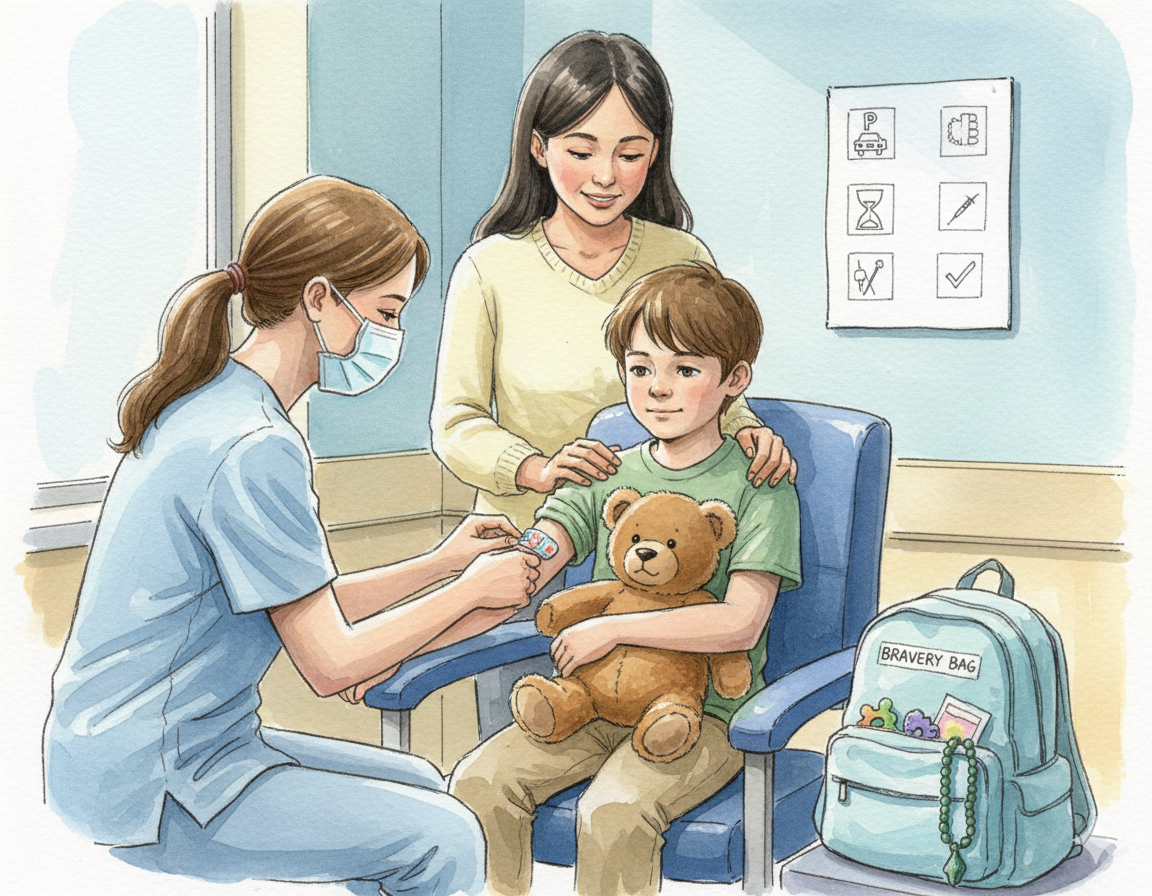
Create a dedicated “Bravery Bag” or “Clinic Kit” filled with carefully selected items that provide comfort, distraction, and sensory regulation. The key is rehearsing with these items at home so they become associated with safety and coping before introducing them in the stressful clinic environment.
Contents to Consider:
- Transitional comfort object: A special stuffed animal, blanket, or object from home that carries familiar scent and texture
- Fidget tools: Items that occupy hands and provide proprioceptive input—fidget cubes, tangles, textured balls, thinking putty
- Chewable items: Chewable jewelry, silicone tubes, or approved chewy snacks that provide oral sensory input (which is naturally regulating)
- Visual distractions: A tablet with favorite videos or games, picture books, or a special toy reserved exclusively for medical appointments
- Sensory regulation tools: Stress balls, weighted lap pad, or small textured items
- Positive reinforcement items: Stickers, stamps, or small tokens that can be earned for completing steps
How to Use the Bravery Bag:
Introduce items progressively during home rehearsals: “Bear is here to hold your other hand during the squeeze. He’s very brave and he’ll help you be brave too.” When the actual appointment arrives, these items serve as bridges between the safety of home and the challenge of the clinic—they’re trusted sidekicks that accompany your child through the difficult experience.
Strategy 4: Post-Appointment Recovery and Reinforcement
The appointment doesn’t end when the needle is withdrawn or the examination concludes. How you handle the immediate aftermath and the days following significantly impacts how your child will approach future medical visits.
Immediate Positive Reinforcement
Celebrate the achievement immediately:
- Enthusiastic, specific praise: “You did it! You sat so still even though the tourniquet was tight. That was really hard and you succeeded!”
- Predetermined reward: This might be a small toy, a favorite snack, a special activity, or extra screen time—whatever is genuinely motivating for your child
- Physical comfort: Hugs, preferred physical contact, or space and quiet time if your child needs to decompress
Processing and Reflection
Within hours or days of the appointment, help your child process and integrate the experience:
- Create a “victory timeline” drawing or photo sequence showing what happened: “We arrived” → “We waited” → “We did the test” → “We celebrated”
- Review what went well: “You remembered to use your fidget cube when you felt worried. That was a brilliant strategy!”
- Acknowledge what was hard: “The smell was really strong. That makes sense—you have a super-sniffer. Next time maybe we’ll bring a tissue with a smell you like.”
- Add successful strategies to your preparation plan for next time
Clinical Debriefing
Keep detailed notes about what worked and what didn’t:
- Which sensory accommodations were most helpful?
- What time of day worked best?
- Which staff members were particularly skilled and understanding?
- Were there any unexpected challenges?
- What would you modify for next time?
Share this information with your child’s medical team. Pediatricians, nurses, and other healthcare providers genuinely want to provide trauma-informed care—they simply need to know what your child specifically needs. Many clinics will add notes to your child’s file about successful strategies, ensuring continuity across future appointments.
Building Long-Term Success
With consistent preparation, thoughtful accommodations, and positive reinforcement, medical appointments can shift from traumatic ordeals to manageable challenges. Each successful experience builds resilience and self-efficacy—your child learns that they can cope with difficult situations, that they have tools and strategies that work, and that discomfort is temporary and survivable.
This isn’t about eliminating all anxiety or making medical procedures pleasant—they may never be pleasant. It’s about making them tolerable, predictable, and achievable, protecting your child from medical trauma while ensuring they receive necessary healthcare.
Remember: you know your child best. These strategies are starting points to adapt and personalize. Celebrate every small victory, learn from every challenge, and know that with patience, preparation, and partnership with understanding medical professionals, you’re building a foundation for a lifetime of more positive healthcare experiences.
References
• Seattle Children’s Autism Blog: Medical Anxiety (2025).
• National Autistic Society: Sensory Processing Guidance (2021).
• Strides ABA: Sensory-Friendly Doctor Visits (2025).
• Fledglings: Sensory Toys for Autism Clinics (2022).
• Autism Parenting Magazine: Calming Sensory Tools (2024).
Leave a Reply